The Electro-Etheric Minotaur
Intro to the Story Collection by Damian Murphy

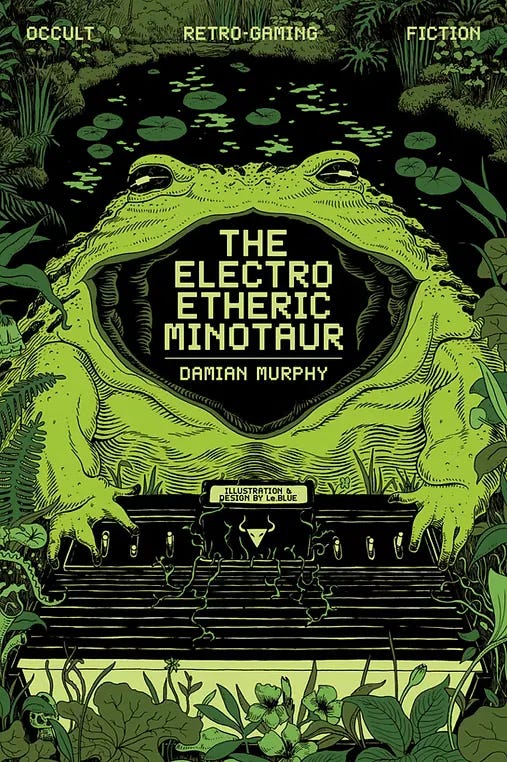
The Electro-Etheric Minotaur is a story collection from Damian Murphy that has just been released by Church Ghost Press. It’s available here:
https://www.churchghost.com/product-page/the-electro-etheric-minotaur
The following is my introduction to the book—which is one of the most significant releases of this decade; beyond essential for anyone hoping to understand the Neo-Decadent current.
Occult fiction has a horror problem.
Which is to say, occult fiction is always being mistaken for something it isn’t: horror, or as it is more likely to be known among the semiliterate these days, “the Weird.”
The trope book is well-thumbed. We have the M.R. James story, the Arthur Machen story, and the Robert Aickman story. Often the approaches are combined, as if these three writers constituted a simple color palette: think of scholarly protagonists encountering mysterious forbidden texts, perhaps while on vacation in an obscure corner of Eastern Europe, before meeting ambiguously unpleasant ends. Usually, the fatal climax is alluded to rather than depicted graphically, but the result is the same: the occult, as a plot device, is reduced to the status of a metaphysical pothole that should be avoided for the sake of one’s continued well-being. Needless to say, the real life existence of countless mentally and physically healthy practicing occultists somewhat gives the lie to this conceit. Which isn’t to say that parallels between entry into the numinous and encounters with horrifying or overawing forces don’t exist: only that this literary mode has been so thoroughly exhausted at this point that to employ it at all is to resort to involuntary pastiche.
A new approach is needed, and who better to provide it than a seasoned practicing occultist? Not a dabbler, but one who has made the disciplined, systematic exploration of the esoteric the focus of their life. Rare enough in practice, but an occultist of this sort who is also an expert writer of fiction? Only a handful of individuals in the world currently meet both these criteria, and Damian Murphy is one of them.
Murphy’s stories and novellas have for a decade now been a staple of the underground. Presses like Ex Occidente/Mt. Abraxas, Egaeus Press, and Snuggly Books have released his work, usually in punishingly limited editions and small print runs, leading to a slowly but steadily expanding audience of committed readers. In contrast to the work of his peers, there is nothing remotely gothic, lurid, ghostly or satanic about his stories, which, to the contrary, often unfold in a spirit of conspiratorial joy and exploratory excitement. Rather than operating in a mystically ambiguous haze of undefined and possibly meaningless portent, his fiction is executed with an architect’s eye for precise detail and structural integrity, and usually concerns characters with very definite, concrete ambitions, which just happen to involve areas of experience that have traditionally been termed “esoteric.”
From the start, Murphy’s serious engagement with occult practice and his sophisticated prose style and original ideas distinguished him from writers on the same presses and in the same anthologies. There was always a sense that he would take things further than the rest: that he had the best chance of breaking the mold entirely and pushing through into some new, as-yet-unimagined literary space.
The present volume presents the culmination of his most radical work. As the title implies, this is a collection of occult retro-gaming stories.
The video game medium is still young enough that its capacity for serious artistic achievement—even its ability to produce something like a towering new Gesamtkunstwerk of literary narrative, graphical ingenuity and immersive gameplay—has only recently achieved widespread acceptance. Within another generation, the notion that it could ever have been in doubt will seem quaint. Yet the stories in this book hearken back to the days of the ZX Spectrum, Atari 2600 and early Nintendo consoles of the 8 and 16 bit eras. By calling back to these earlier systems with their graphical limitations, Murphy is invoking primal childhood experiences with the mystical otherworlds flickering behind CRT screens.
Although the juxtaposition of occult ritual and modern electronic gaming may at first seem incongruous, anyone who has ever pursued either activity seriously will have had intimations of the other. Notions of secret areas and strategies, exploitable glitches and hidden codes always formed part of the gaming experience, and all of them have their correspondences in occult practice. And the parallels between the astral double and the avatar of a video game character are obvious, but had yet to be explored seriously in fiction until now. As Stella, the ardent solitary gamer protagonist of “A Mansion of Sapphire,” reflects:
Etheric pulses, astral emanations, rhythmic tides and the alignment of sheathes—her progress in the game found its unlikely analog in the interlocking segments of the soul.
Recent video games such as Disco Elysium, Expedition 33 and the like have included branching narratives and a focus on characterization, exploration and deep engagement that arrives at true literary sophistication. Murphy’s innovation here is to reach the same place from the opposite direction, creating an entire subterranean universe of classic games that never existed and never really could exist, though their plausibility as one reads is never in doubt. We feel that game designers like Leoparella in “Magnetic North” and Fernando Mateo Ramírez in “Hallazgo” must really be out there somewhere, in a space that intersects only marginally with conventional channels of access, clandestinely distributing their esoteric retro adventures to the discerning few. It amounts to a true counterhistory, suggesting that video games and occultism were ALWAYS connected at a fundamental level, down to the primal physical forces involved. As the nomadic designer in “Magnetic North” explains:
The next phase will focus on the materials themselves, particularly in terms of the type of magnetic storage used in data cassettes and floppy disks. I’ve purposely held off on making use of this technology, but I think the time has come to do so. It’s an ideal medium for the aspects of my work that seek new forms of expression—magnetic north, the dreams of the butterfly, several other things I haven’t mentioned.
The level of casual invention on display here is considerable. Throughout these stories, we receive descriptions of games based on religious poems, Italian horror comics, Zen koans, French New Wave films, and Ingmar Bergman’s The Hour of the Wolf. It’s a pleasure in itself to contemplate what playing these impossible games would be like, but Murphy’s original inventions take center stage. In “Night Lamp Lotus” we are treated to a 16 bit counterfeit JRPG from Serbia containing maniacally nonlinear gameplay based around parlor games at upscale soirees and invocations of obscure etheric forces in bathhouses; needless to mention, the game’s apparent unsolvability is its ultimate appeal. “Hallazgo” presents heavily-footnoted apocryphal accounts of a retro adventure designed by a Spanish anarchist poet; the cinematic descriptions of its gameplay sound like snatches of Herzog or Tarkovsky films from an alternate timeline. In our present era of increasingly artistic indie games, Murphy suggests their development taken to its arcane yet logical conclusion: entirely Hermetic games produced and distributed in near total obscurity, for a vanishingly small audience of sophisticates. Often, these games are described as having content differences down to the level of the individual copy, making attempts at producing strategy guides creative exercises in futility. It’s a level of complexity that could never have been achieved with the hardware Murphy specifies, yet it captures something genuine about where true avant-garde game design is currently headed.
The central novella “A Night of Amethyst” takes the premise even further, presenting itself in the form of an old-style text adventure. Here, form and content fuse: reading the story is akin to playing the imaginary game itself. The concept is executed so perfectly that it seems incredible that no one has attempted anything like it before, although, as stated, few writers now active would seem to have the skill set needed to execute something like this so masterfully.
With this book, Damian Murphy gives the clearest possible answer to the question: if occult fiction isn’t horror, then what is it? To the extent that electronic gaming allows us to experience the unity of the microcosm and the macrocosm, Murphy’s stories establish an entirely unique genre, and one which any future explorers of this space will have to reckon with as their template.
Art by LeBlue